
If you’re planning a trip to York, England, you won’t want to miss the impressive York Minster Cathedral. This stunning Gothic-style cathedral is one of the largest of its kind in Northern Europe and boasts an impressive history dating back to Roman times. In this guide, we cover some fascinating facts about York Minster that you may not have known before.
Facts About York Minster
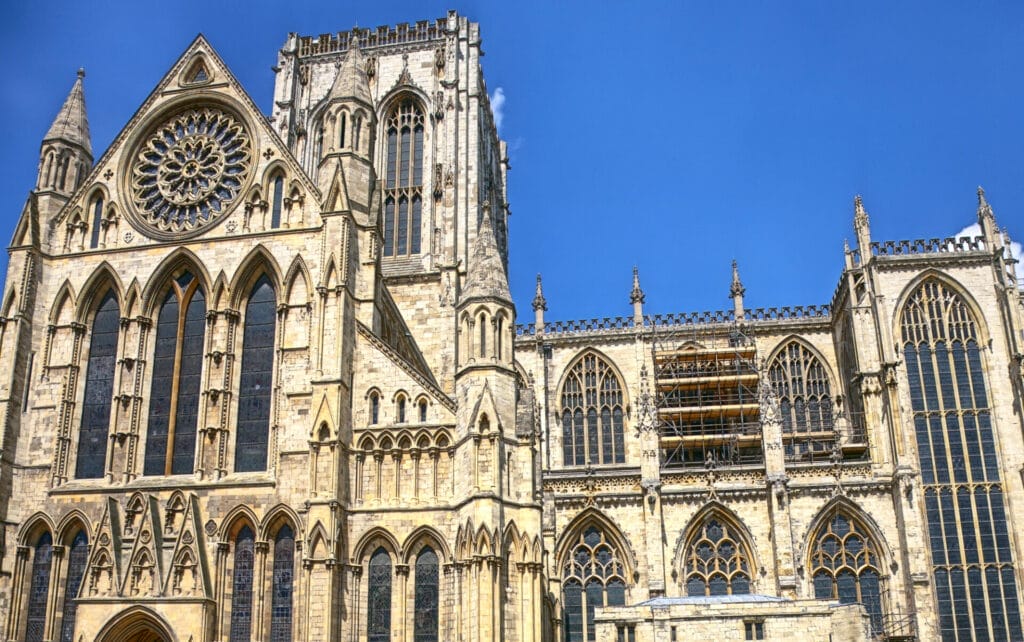
York Minster is a Gothic-style cathedral located in the city of York, England. The cathedral is the seat of the Archbishop of York, and it is known for having Britain’s richest collection of stained glass. The Minster is also the largest Gothic church in England.
When was York Minster Built?
York Minster dates back to the Anglo-Saxon period when the city of York was known as Eboracum. The city was an important stronghold in Britain, and it was the site of an important Roman basilica. In 627 AD, King Edwin of Northumbria was baptized in a wooden church on the site where York Minster now stands.
After the Norman Conquest in 1066, the Normans rebuilt the church in stone. The church was later expanded during the 13th and 14th centuries. The Minster was completed in 1472 after several centuries of building.
Related Posts
How Old is York Minster?
Construction began in 1220 and was completed in 1472, making the current version of York Minster over 550 years old!
How High is York Minster?
York Minster stands impressively tall, with its central tower reaching a height of 235 feet (72 meters). The two western towers, which form the iconic twin-tower façade of the cathedral, each rise to 202 feet (61.5 meters).
What Religion is York Minster?
York Minster is an Anglican cathedral, serving as a prominent place of worship within the Church of England. As the seat of the Archbishop of York, the second-highest office in the Church of England, it plays a significant role in Anglican religious practices and ceremonies. The Minster hosts regular services, including daily prayers, Eucharist, and major religious festivals, following Anglican liturgy and traditions.
What important events have taken place at YOrk Minster?
Coronation of Constantine the Great (306 AD)
One of the most significant events in York Minster’s history is the coronation of Constantine the Great. Although the original wooden church predated the current Minster, Constantine’s ascension to Emperor of Rome in York marked a pivotal moment in both Roman and Christian history.
The Baptism of King Edwin of Northumbria (627 AD)
The first York Minster, a wooden church, was constructed for the baptism of King Edwin of Northumbria, a crucial event in the Christianization of the Anglo-Saxons. This ceremony marked the beginning of York Minster’s long-standing religious significance.
The Great East Window (1405-1408)
The creation and installation of the Great East Window, the largest expanse of medieval stained glass in the world, took place between 1405 and 1408. This event is significant for its artistic achievement and for enhancing the Minster’s aesthetic and spiritual ambiance.
The English Civil War (1642-1651)
During the English Civil War, York Minster was a focal point for conflict. Royalist troops fortified the Minster, and it suffered damage from Parliamentarian forces. The war significantly impacted the city and the cathedral, marking a turbulent period in its history.
Restoration by Sir George Gilbert Scott (1858-1874)
In the 19th century, York Minster underwent major restoration under the direction of Sir George Gilbert Scott. This restoration was crucial in preserving the structural integrity and beauty of the Minster, ensuring its survival for future generations.
Royal Visits and Ceremonies
York Minster has hosted numerous royal visits and ceremonies, including the marriage of Prince Edward in 1983. These events underscore its importance as a national and royal landmark, playing a key role in the United Kingdom’s ceremonial life.
Installation of the Archbishop of York
As the seat of the Archbishop of York, the Minster has been the site of many significant ecclesiastical ceremonies, including installations of archbishops. These events highlight York Minster’s enduring role in the Church of England and its spiritual leadership.
Who is the Archbishop of York?
The Archbishop of York is Stephen Cottrell. He was installed as the 98th Archbishop of York on July 9, 2020, succeeding Dr. John Sentamu.
Architectural Styles

York Minster is a magnificent cathedral that showcases different architectural styles. The original structure was built in the Norman style, but it was soon remodeled in the Gothic style in the mid-12th century. The Gothic style was about reaching towards the sky, with pointed arches, lots of light, and ornamentation. The new Gothic style was built on and around the existing Norman Minster, which dates back to 1080.
The Gothic style can be further divided into different phases, including Early English, Decorated Gothic, and Perpendicular Gothic. Early English Gothic is characterized by pointed arches, ribbed vaults, and flying buttresses. Decorated Gothic is known for its intricate tracery, ornate carvings, and large windows. Perpendicular Gothic, on the other hand, is characterized by vertical lines, fan vaulting, and large windows with mullions and transoms.
York Minster also showcases elements of the Roman basilica and the basilica plan. The basilica plan is characterized by a long nave, side aisles, and an apse at the end. The nave is the central area of the church where the congregation sits, while the side aisles are the walkways on either side of the nave.
Significant Features

York Minster is a stunning example of Gothic architecture, and it boasts several significant features that make it a must-visit for anyone interested in religious history or architecture.
One of the most impressive features of York Minster is its collection of stained glass windows. The cathedral has Britain’s richest collection of medieval stained glass, including the Great East Window, which is the largest expanse of medieval stained glass in the world. The Five Sisters Window is another standout feature, consisting of five lancet windows that date back to the 13th century.
The Rose Window is another must-see feature of York Minster. Situated in the North Transept, this stunning piece of stained glass is over 16 feet in diameter and features intricate designs that are sure to impress.
The Western Towers are another impressive feature of York Minster. These towers date back to the 14th century and are over 200 feet tall. Visitors can climb to the top of the towers for a breathtaking view of the surrounding area.
The Central Tower, also known as the Lantern Tower, is another impressive feature of York Minster. This tower is the highest point of the cathedral, standing at over 235 feet tall. Visitors can climb to the top of the tower for an unforgettable view of York.
The Nave is another impressive feature of York Minster. This central area of the cathedral is over 300 feet long and features stunning vaulted ceilings and intricate carvings.
The Chapter House is another must-see feature of York Minster. This circular room dates back to the 13th century and features stunning carvings and a beautiful central column.
Finally, the Lady Chapel is another impressive feature of York Minster. This chapel dates back to the 14th century and features stunning vaulted ceilings and intricate carvings.
Role and Function
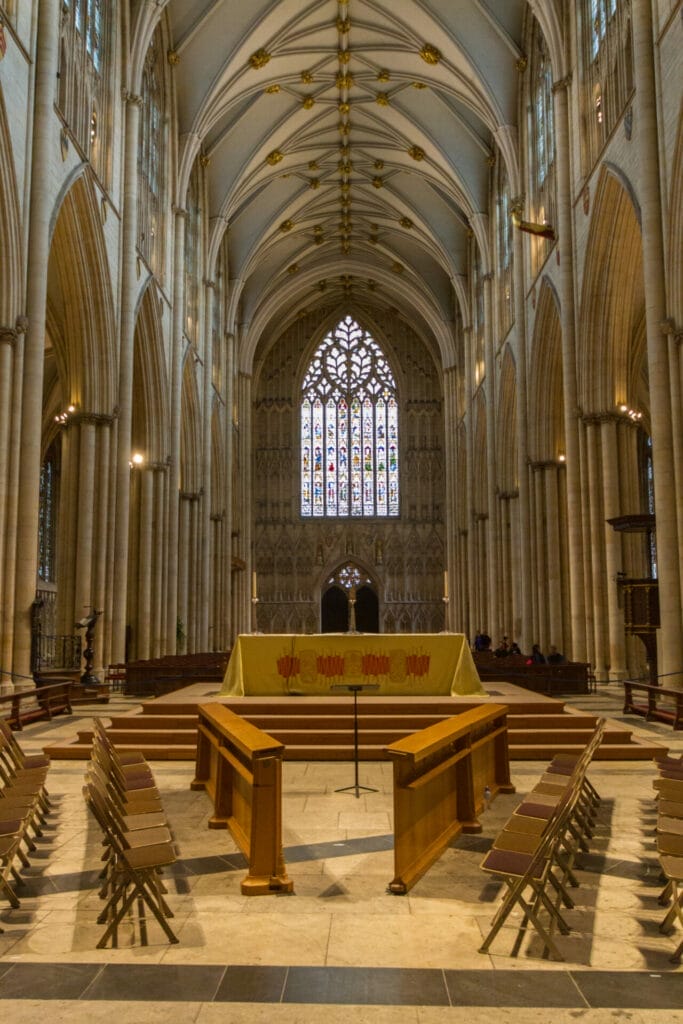
York Minster is the seat of the Archbishop of York and is the mother church of the Diocese of York. It is also the Metropolitical Church of the Province of York. As a result, it is one of the most significant churches in the Church of England.
The church has a long history dating back to Roman times when a basilica was built on the site. It was later replaced by a Norman church, which was then rebuilt in the Gothic style in the 13th century. The cathedral has played a significant role in the development of Christianity in England, and it continues to be an important place of worship today.
The role of the Archbishop of York is to oversee the Diocese of York and to act as a representative of the Church of England. The Archbishop is also responsible for the governance of the Province of York, which includes twelve dioceses in the north of England.
As a High Church and Anglo-Catholic cathedral, York Minster has a strong emphasis on liturgy and sacraments. It is known for its rich history and tradition, and it attracts visitors from all over the world.
The cathedral is dedicated to Saint Peter, who is considered the patron saint of fishermen. The church has a strong connection to the fishing industry, and it has a number of references to fishing in its architecture and decorations.
MOre Facts About YOrk Minster

York Minster is a magnificent cathedral located in the heart of Yorkshire, England. Here are some interesting facts about this historic landmark that you might not know:
- Fire has been a recurring issue for York Minster throughout its history. The most devastating fire occurred in 1984, which destroyed the south transept roof and caused significant damage to the building. The restoration work took four years and cost around £2.5 million.
- In 1967, Blue Peter, a popular children’s TV show, launched a fundraising campaign to restore the cathedral’s Great East Window. The campaign was a huge success, raising over £30,000.
- York Minster is often referred to as the “Heart of Yorkshire” due to its central location in the county.
- The cathedral’s full name is the Cathedral and Metropolitical Church of St Peter in York.
- Mistletoe plays a significant role in the cathedral’s history. Every year, during the Mistletoe Service, a sprig of mistletoe is hung from the high altar. This tradition dates back to the time of the Druids.
- York Minster has its own police force, which is responsible for the security and safety of the building and its visitors.
- The cathedral’s astronomical clock is one of the oldest in England, dating back to the 15th century.
- In 1981, a lightning bolt struck the cathedral’s central tower, causing significant damage. The tower was later enlarged to prevent a similar incident from happening again.
These are just a few of the many interesting facts about York Minster. A visit to this iconic landmark is a must for anyone interested in history and architecture.
Important Figures at York

York Minster has been home to many important figures throughout its long history. Here are some of the key personalities associated with the cathedral:
- Thomas Wolsey: Thomas Wolsey was an English bishop and statesman who served as the Archbishop of York from 1514 to 1530. He was one of the most powerful men in England during the reign of King Henry VIII and was instrumental in the construction of the Minster’s Great East Window.
- Master Glazier Robert Petty: Robert Petty was the master glazier responsible for the creation of the Great East Window, which is the largest expanse of medieval stained glass in the world. Petty oversaw a team of craftsmen who worked on the window for over 20 years, from 1405 to 1425.
- Jonathan Martin: Jonathan Martin was a man who set fire to the Minster’s choir screen in 1829. The fire caused extensive damage to the cathedral and it took over 20 years to fully restore it.
- Dean and Chapter: The Dean and Chapter is the governing body of the cathedral, responsible for its administration and upkeep. The Chapter is made up of the Dean, the Precentor, the Chancellor, the Treasurer, the Archdeacon of York, and several canons.
- Metropolitical: York Minster is the seat of the Archbishop of York, who holds the third-highest office in the Church of England after the monarch and the Archbishop of Canterbury. The Archbishop of York is responsible for the northern province of the Church of England, which covers much of the north of England.
York Minster in Popular Culture
York Minster has been featured in popular culture in various forms. One of the most notable appearances was on the British children’s TV show, Blue Peter. In 2005, the show featured a segment on the cathedral, highlighting its history and architecture. The segment also showed the presenters taking part in a choir rehearsal and climbing the tower to get a bird’s eye view of the city.
The cathedral has also been featured in various films and TV shows. In the 1996 film, “The Secret Agent,” the cathedral was used as a filming location. It was also featured in the 2007 film, “The Golden Compass,” as a stand-in for Jordan College in Oxford. The cathedral has also been used as a filming location for episodes of the TV shows, “Victoria” and “Doctor Who.”
York Minster has become a symbol of Yorkshire and is often referred to as the “Heart of Yorkshire.” It is a popular tourist destination and attracts millions of visitors each year. The cathedral has also been the site of many important events, including the coronation of King George VI and Queen Elizabeth in 1937.
Want to learn more about York Minster? Read about visiting the York Minster Cathedral here or learn more facts about York here.
Looking for ways to save money on your trip to York? Grab yourself a York Pass for a fixed price discounted access to 20+ attractions including York Minster Cathedral and Tower.


